
Continuing the Zouave Cause
The League of St. Sebastian
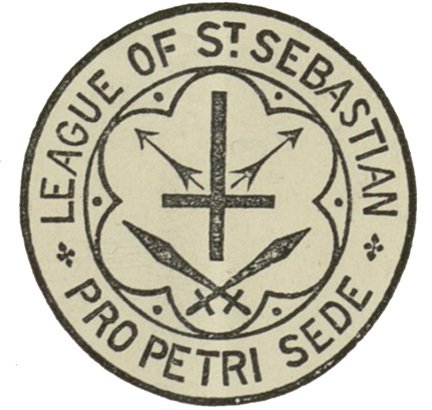
Emblem of the League of St. Sebastian. Annual Report of the League, 1875.
On 14 October 1870 the steamship India arrived in Liverpool after a long, difficult journey from Livorno, carrying many of the surviving British (and some Canadian) members of the Pontifical Zouaves. Rome had fallen and the atmosphere at the docks was muted; nevertheless, a small crowd awaited them, and a banquet was held for a select group at the city’s prestigious Adelphi hotel. The Zouaves then dispersed and returned to their homes, their expenses being met, if necessary, by the Papal Defence Committee. One Zouave, Frederick Woodward, arrived gravely sick and died three days later, having been nursed by the Oblate Fathers. He was buried at Anfield Cemetery.
This was not, however, the end of the story; nor were the campaigns and duties of the Zouaves between 1861 and 1870 its beginning. It is important to stress that the Pontificate of Pius IX saw a huge mobilisation of the Catholic laity in defence of the pope and his temporal power. Aided by speedier transport and communications, and an increasingly confident and politicised laity, associations were formed, collections made for Peter’s Pence, petitions and protests signed, pamphlets and journals published, meetings arranged, and pilgrimages organised. It is within this context that we should see the volunteer movement to bear arms in defence of the Holy Father.
Having returned home, the Zouaves and their supporters were keen to continue the cause. Pius IX suggested that ‘in all countries the Catholic Laity, in conjunction with the Clergy, should form themselves into Associations for the defence of Catholic interests’ in general and the temporal power in particular.1 An international gathering of concerned laity took place in Geneva at the end of October 1870, a matter of weeks after Porta Pia, to discuss the material support of the pope (now without a kingdom), organise a transnational movement to protest against the taking of the temporal power and work for its restoration, and establish an “Office of Correspondence and Information.” The aim, reported The Tablet, was the formation of a “Universal Catholic Brotherhood” which would not only work for the pope’s sovereignty but “advance the social Reign of Christ on earth.”2
By 26 December 1870, 503,347 signatures had been added to a “Filial Address” to the pope from British Catholics. A large meeting was held at St James’ Hall in London, with the Archbishop of Westminster in the chair. It resolved that the “violent occupation of the City of Rome” was sacrilegious, that it constituted an attack on the liberty of the Church and the “dispositions of Divine Providence,” and that it violated not only papal sovereignty but “the rights on which all Civil States are founded.”3 Similar events were held in Ireland; during a meeting held at Thurles Cathedral, the MP for Tipperary stated that “the youth of our country are ready once more to don the uniform of the famous Papal Zouave (loud cheers)—and to join in a new crusade to recover for the Holy Father his ancient dominions (loud cheers).”4
In the aftermath of the fall of Rome, new Catholic associations were formed. On 10 February 1871 the Catholic Union was established in London, under the presidency of the Duke of Norfolk, exclusively consisting of Catholic laymen and aiming to promote the restoration of the temporal power by legal means and “concentrate the moral influence of the whole Catholic world on public opinion and to keep alive in the consciences of men the sense of public crime.”5 This was soon broadened to represent all issues of Catholic interest; the organisation continues today, acting as a witness to the Faith in the public square.
Closely associated with the Catholic Union was the League of St Sebastian, the subject of this article, which was established a few days later on 13 February 1871. It consisted primarily of those who had served under the colours of Pius IX to promote his legitimate rights as Sovereign of the Papal States and stand ready for action, if appropriate. Unlike the Catholic Union, it was seen as a military organisation, especially in its early days. When a Te Deum was arranged for the pope’s jubilee at London’s Italian Church in 1871, for example, a League advertisement stated that “all ex-Pontifical soldiers are requested to attend” in uniform.6 St Sebastian seemed an appropriate patron: a member of Diocletian’s Imperial Guard who had been martyred for the Faith and transfixed with arrows—a symbol of a Church that was both militant and suffering.
Membership
Membership of the League grew quickly: in January 1872 there were 394 members and a year later 824, including 66 “active” members. Most lived in England but there were 330 in Ireland and 101 in Scotland.7 There was a distinction between “active” and “honorary” membership, borrowed from other Victorian associations, such as the Rifle Volunteers that could be found in most British localities from 1859, when an imminent invasion from Napoleon III’s France was feared.
Active League members were soldiers-veterans of the papal army, mostly former Zouaves-who paid an annual subscription of 10 shillings; initially only these could serve on the Council. Honorary members paid 5 shillings and could be of either gender. Such a subscription was, by definition, only open to the wealthier classes, at a time when an agricultural labourer (for example) earned around 12 shillings a week. With this in mind, associate membership was available for a yearly sum of 1 shilling.
Upper class supporters included the Duke of Norfolk (the premier non-royal peer), the Marquess of Bute (regarded as the wealthiest man in Britain), the Earls of Denbigh and Gainsborough (both previously involved in the Papal Defence Committee, which had supported Zouave volunteers), the Earl of Granard (an Irish peer who had converted to Catholicism in 1869), the Marchioness of Lothian (one of Manning’s converts, married to a prominent Tory politician), Countess Tasker of Middleton Hall, Brentwood (who had inherited a vast fortune from her businessman father Joseph Tasker and was subsequently ennobled by the pope), and Lord Walter Kerr (who would end his naval career as Admiral of the Fleet).
